
Is Insetting the new Offsetting? A practical guide for STR managers and owners
The future of sustainable STRs: Is Insetting game changing?

If you’re managing a short-term rental, you’ve probably heard about carbon offsetting—maybe even considered it as part of your sustainability efforts. On paper, it sounds great: you buy carbon credits to “cancel out” your emissions by funding projects like tree planting or renewable energy. But here’s the thing—offsetting is gaining a controversial reputation. Many projects fall short of delivering their promised environmental benefits. In some cases, businesses use offsets to appear sustainable without making meaningful changes. Plus, let’s be honest: does telling your guests you “purchased carbon credits” make them feel like they’re staying greener?
That’s where carbon insetting comes in. Instead of paying for sustainability elsewhere, insetting means making direct changes to your rental property and business operations to cut emissions at the source. Think of it as doing more good instead of just balancing out the bad. The best part? It’s better for the environment, makes your STR more appealing to eco-conscious guests, and can even lower your running costs. Let’s learn how.
If you’re just starting to explore the possibilities of smart tech in your properties, this blog is tailored for you. We’ll unpack why and how embracing these technologies can greatly enhance the competitiveness, appeal, and sustainability efforts of your properties.
Offsetting vs. Insetting: What’s the difference?
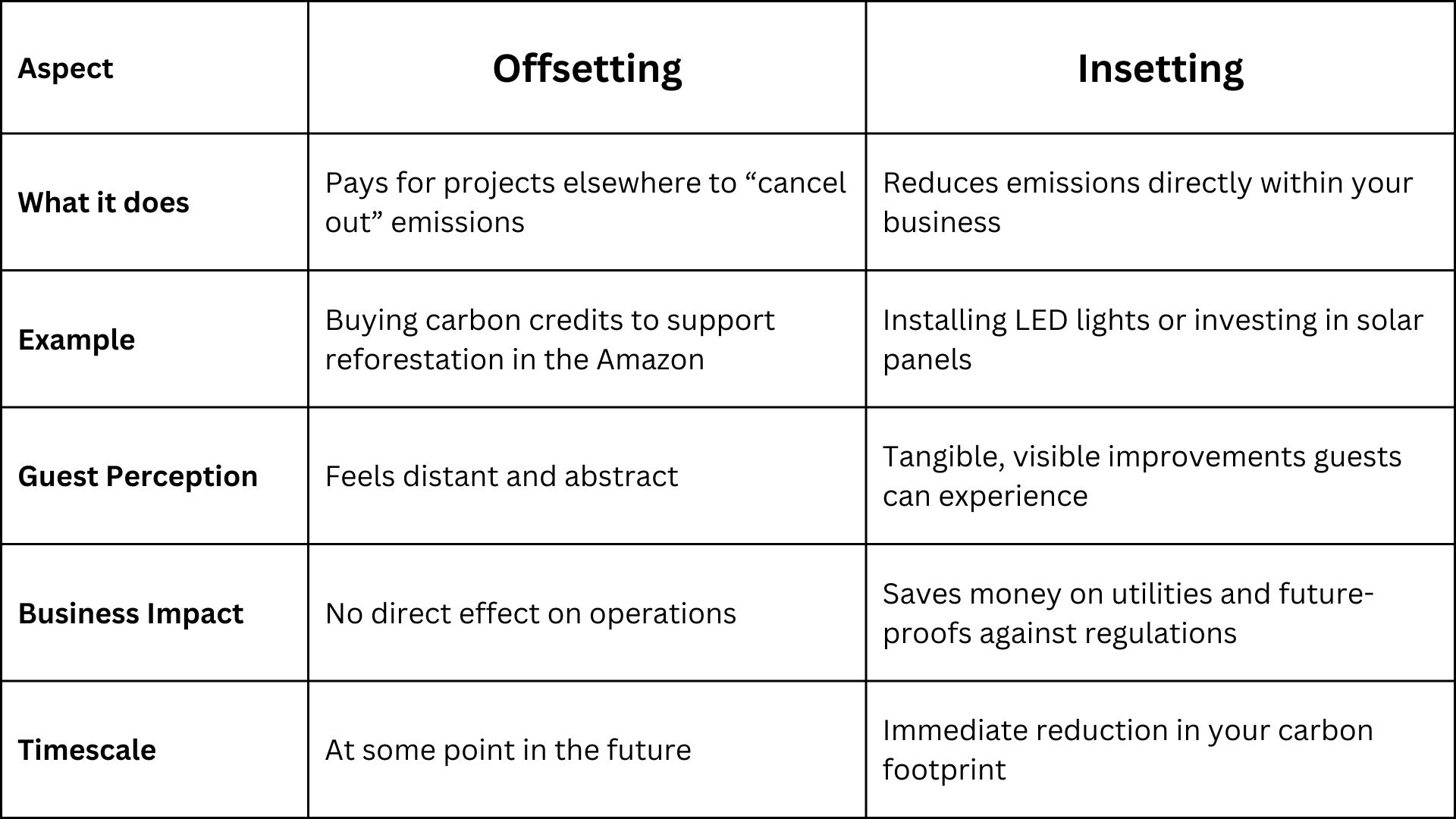
Offsetting has its place, but today’s guests and regulators are looking for tangible action. The question to consider is—how certain are you that your offset payments are genuinely making a measurable impact?
Why offsetting alone won’t cut it for STRs anymore

Offsetting has been under fire for several reasons:
1. Double counting issues
One of the biggest problems with offsetting is that the same carbon reduction can sometimes be sold multiple times. Imagine you pay for a project that claims to reduce one ton of carbon emissions. But if another company is also counting that same ton of CO₂ savings, then the environmental benefit isn’t actually doubled—it’s just being counted twice on paper. This lack of accountability means the true impact of offsetting is often inflated, making it difficult to know whether your contribution is actually making a difference.
2. Lack of transparency
Many offset projects sound great in theory, but there’s minimal real-world tracking of their effectiveness. For example, if you purchase credits to fund a tree-planting initiative, how can you be sure those trees will survive long enough to sequester the promised amount of carbon? What if the land is cleared in a few years? Many offset projects operate in distant locations, making it more difficult for businesses or auditors to verify their long-term effectiveness. This lack of transparency makes it challenging for STR managers to confidently say their offsets make a real difference.
3. No direct impact on your business
One of the biggest downsides of carbon offsetting is that it does nothing to improve your STR operations directly. When you purchase carbon credits to fund projects elsewhere, your business remains unchanged—you’re still using the same amount of energy, generating the same waste, and running at the exact operational costs. Offsetting is essentially paying to make the problem “go away” elsewhere. It might look good in marketing, but it doesn’t change the reality of your day-to-day business operations.
4. Greenwashing accusations
Travellers are becoming more environmentally conscious and can spot surface-level sustainability efforts. Many now see offsetting as a way for businesses to buy a green image without taking real action. Instead, they prefer accommodations that actually cut emissions, such as using energy-efficient lighting, eliminating single-use plastics, or sourcing sustainable toiletries and furnishings. Greenwashing—a term used when businesses claim to be sustainable without meaningful action—can seriously hurt your reputation. STRs that rely solely on offsetting without insetting, risk losing credibility with eco-conscious travellers.
Are you saying offsetting is all bad?
Like most things in life, it is all about balance and finding what works for your business. We are not saying that offsetting is all bad, it can have its place and have real benefits for communities and in sequestrating carbon emitted. Think of it as one tool in your sustainability toolbox but not as a panacea to fix all your business carbon footprint issues. It is certainly not a ‘get out of jail card’ whereby you offset and then make no other changes within your business to reduce your emissions.
Why STRs should still reduce emissions?
Over the past decade, ESG policies have driven sustainability commitments across industries, including hospitality and travel. Many companies used carbon offsetting as a key component of their ESG strategies, purchasing carbon credits to neutralise emissions. However, offsetting is now facing significant scrutiny from both regulators and consumers:
- The EU’s Green Claims Directive will ban misleading sustainability claims that cannot be proven.
- The UK’s Advertising Standards Authority (ASA) has already penalised airlines and travel companies for misleading offsetting claims.
- Reports from The Guardian and Greenpeace found that 90% of rainforest carbon offsets sold by some providers were “worthless”.
- In the US, several states have introduced anti-ESG legislation.
Despite the backlash, one thing is clear: sustainability still matters to travellers. Even as ESG policies evolve, consumer demand for greener travel only strengthens. 90% of travellers want sustainable travel options, but 70% struggle to find them. 71% of guests say they prefer booking eco-friendly accommodations, but 43% recognise and expect their travel service providers to play a key role in addressing environmental issues. This data shows that guests actively seek out sustainable stays but struggle to find clear, trustworthy options. This is where insetting becomes a key competitive advantage.
How to get started with Insetting in your STR?
So, what does insetting actually look like for an STR? Here are some practical ways to inset carbon emissions in your rental business. Before jumping into solutions, take a step back and assess where your STR consumes the most energy, water, and resources. The key areas typically include:
- Energy use: Heating, cooling, lighting, and appliances.
- Water consumption: Showers, laundry, kitchen use, and irrigation.
- Waste generation: Single-use plastics, packaging, and food waste.
- Supply chain: Where your furniture, toiletries, and cleaning products come from.
- Guest behaviour: How guests interact with energy, water, and waste systems.

1. Make energy efficiency a priority
Energy use is often the biggest contributor to an STR’s carbon footprint. Instead of buying carbon credits to “cancel out” your emissions elsewhere, focus on reducing the energy demand of your property. This can be done by:
- Upgrading to LED lighting – LEDs use up to 75% less energy than traditional bulbs and last longer, reducing electricity consumption and maintenance costs.
- Installing smart thermostats – Automating heating and cooling based on guest occupancy can significantly reduce wasted energy. A well-programmed thermostat can cut energy use by 10-15% annually.
- Replacing outdated appliances – Replacing outdated fridges, washers, or AC units with modern energy-efficient models can help reduce electricity bills and long-term costs.
- Adding insulation and draught-proofing – Proper insulation can reduce heating and cooling costs by 20%, making it one of the most cost-effective upgrades.
How to track impact: Compare your electricity bills before and after upgrades, install a smart meter to monitor real-time energy use and track kWh consumption per guest stay.
2. Reduce water waste without compromising guest comfort
Water waste is another major issue for STRs, especially in areas prone to water shortages. Instead of relying on offsetting schemes that promise future benefits, insetting allows you to make a direct impact now.
- Install low-flow showerheads and taps – Modern low-flow fixtures maintain strong water pressure while reducing water use by 30% or more.
- Use dual-flush toilets – These can save up to 67% water compared to older toilet models.
- Encourage towel and linen reuse – Simple signage informing guests that reusing towels saves ‘x’ litres of water per stay can dramatically reduce laundry-related water consumption.
- Implement greywater recycling – If feasible, collect water from sinks and showers for garden irrigation.
How to track impact: Measure water bills before and after changes, track how often guests reuse towels and monitor taps and showers’ flow rate.
3. Cut down on waste and single-use plastics
Waste is a massive problem in the STR industry, mainly when guests use single-use plastics and disposable products. Instead of purchasing carbon offsets to compensate for landfill waste, reduce waste at the source by making smart choices.
- Eliminate single-use plastics – Provide refillable toiletries, reusable shopping bags, and glass water bottles instead of disposable ones.
- Set up clear recycling and composting stations – Many guests want to recycle but don’t know how to do so. Labelling bins properly makes it easy for them.
- Offer locally sourced welcome packs – Instead of imported snacks wrapped in plastic, provide guests organic, package-free treats from local vendors.
How to track impact: Weigh your waste output before and after changes, track how many plastic bottles/toiletries you eliminate per stay, and monitor how well guests use recycling bins.

4. Choose sustainable suppliers for your STR
Another overlooked aspect of sustainability is your supply chain. The products you buy—furniture, cleaning supplies, or bedding—all have a carbon footprint. Instead of buying cheap, mass-produced goods that require offsetting later, invest in sustainable alternatives.
- Buy furniture locally or second-hand – Upcycled and reclaimed wood furniture reduces deforestation and emissions from shipping.
- Use eco-friendly cleaning products – Many mainstream cleaning products contain chemicals harmful to the environment and guests. Choose biodegradable, non-toxic alternatives.
- Opt for sustainable linens and bedding – Organic cotton and bamboo-based textiles have a lower environmental impact than conventional bedding.
How to track impact: Keep records of purchases and switch to local suppliers with transparent sustainability credentials.
5. Engage guests in sustainability efforts
One of the most potent aspects of insetting is that it allows you to educate and involve guests in your sustainability efforts. Unlike offsetting, where guests never see the impact, insetting creates a more meaningful experience.
- Provide digital guest guides – Instead of printing paper instructions, use an app or tablet to share check-in details, local recommendations, and sustainability tips.
- Offer incentives for eco-conscious behaviour – Some hosts offer small discounts to guests who use public transport, participate in waste reduction, or opt out of daily towel changes.
- Educate guests about your green initiatives – A simple note saying, “This STR is powered by 100% renewable energy” or “Your shower saves 30% more water than standard models” can make guests more mindful of their impact.
How to track impact: Monitor guest feedback, encourage reviews that mention sustainability, and see if eco-conscious choices affect booking rates.
Final thoughts: take action and stay ahead
Let’s be honest—greenwashing won’t cut it anymore. Guests are getting smarter, regulations are tightening, and buying offsets isn’t enough. If you want your STR to stand out, you must show, not just tell.
But here’s the good news: sustainability doesn’t have to be overwhelming. With EnviroRental’s free sustainability resources, including our EnviroRental Sustainability Roadmap, we provide a structured, step-by-step approach explicitly tailored for STR owners and managers. Our expertly curated content simplifies sustainability, equipping you with the knowledge and tools to implement meaningful changes.
Your tiniest act of support means the world to us!
EnviroRental is committed to offering all our resources for free to our subscribers because we don’t want anything to get in the way of you taking action. We do have sponsors who support much of our work and we are incredibly grateful for their commitment but it is unrealistic to expect them to do all the financial heavy lifting. If you would like to support our work with a modest donation we would be very grateful. As a not-for-profit, we work really hard to make every penny count.
Explore Other Resources:
Let’s not underestimate the power of small changes
We highly recommend checking out our bespoke collection of free EnviroRental resources, crafted exclusively for the STR industry, to help you confidently navigate your next steps towards sustainability.
Explore More EnviroRental Resources

How to get your sustainable vacation rental listed on eco-booking platforms
Make your holiday rental stand out with eco-booking sites: steps, sites & strategy

2025 Booking.com Travel & Sustainability Report
If you run a short-term rental, here’s how this analysis could shape your strategy going forward.

Booking.com 2025 Sustainable Travel Report
Booking.com released the 10th edition of its annual research exploring consumer attitudes and intentions regarding the social and ecological impact of travel